

VitalStatistix
Optimised Revenue Cycle & Supply Chain Operations
Reduce revenue leakage & margin erosion across purchase, inventory, consumption and revenue operations, not just claims
Revenue is lost at every stage: claims delayed by manual data assembly, deductions that go unchallenged, packages priced below their true cost, missed charges, payer guidelines absorbed too late, excess stock & costly stockouts. HealthFoundry's FinOps agents work across the full revenue & supply chain cycle, surfacing leakage, quantifying its financial impact, and supporting your team to act on it, while keeping humans in control of every consequential decision.
What We Address
Revenue leakage & margin erosion occurs across three domains.
We address all three.
Don't just manage revenue. Plug every leak eroding your margin. RCM tracks your revenue. We do that & protect your margins.
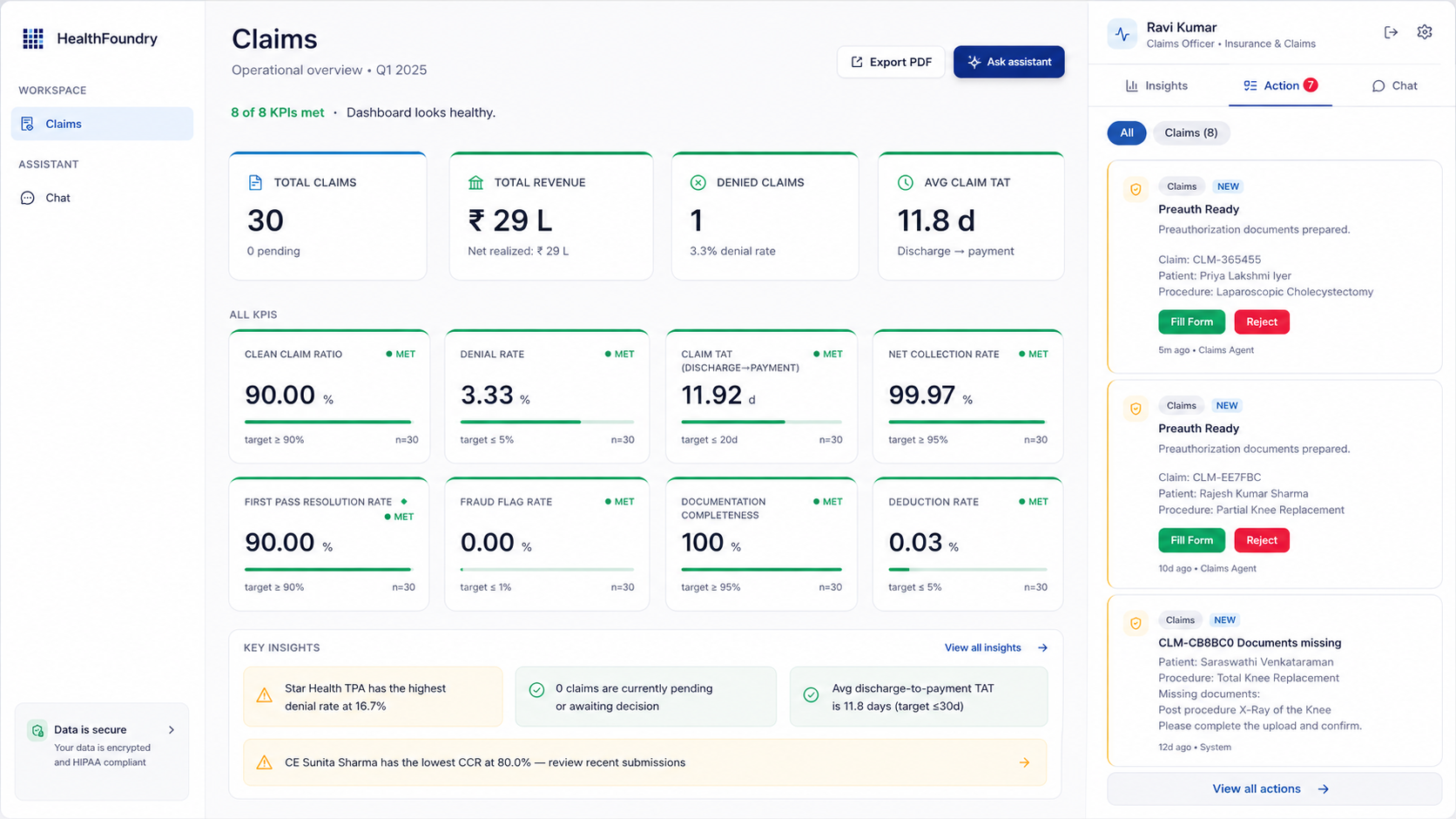
Claims Management & Payor Intelligence
The eight stage claims lifecycle, from eligibility verification through settlement reconciliation, with agents reducing manual assembly time, query backlogs, and rejection rates.
Charge Capture & Package Profitability
Agents to plug billing errors and charge capture gaps, analysing billing against reimbursable amounts to identify where packages are delivered at a loss, and recommending package master optimisations that improve margins without compromising care quality.
Smart Inventory
Balance inventory to eliminate tied-up capital and stockouts.
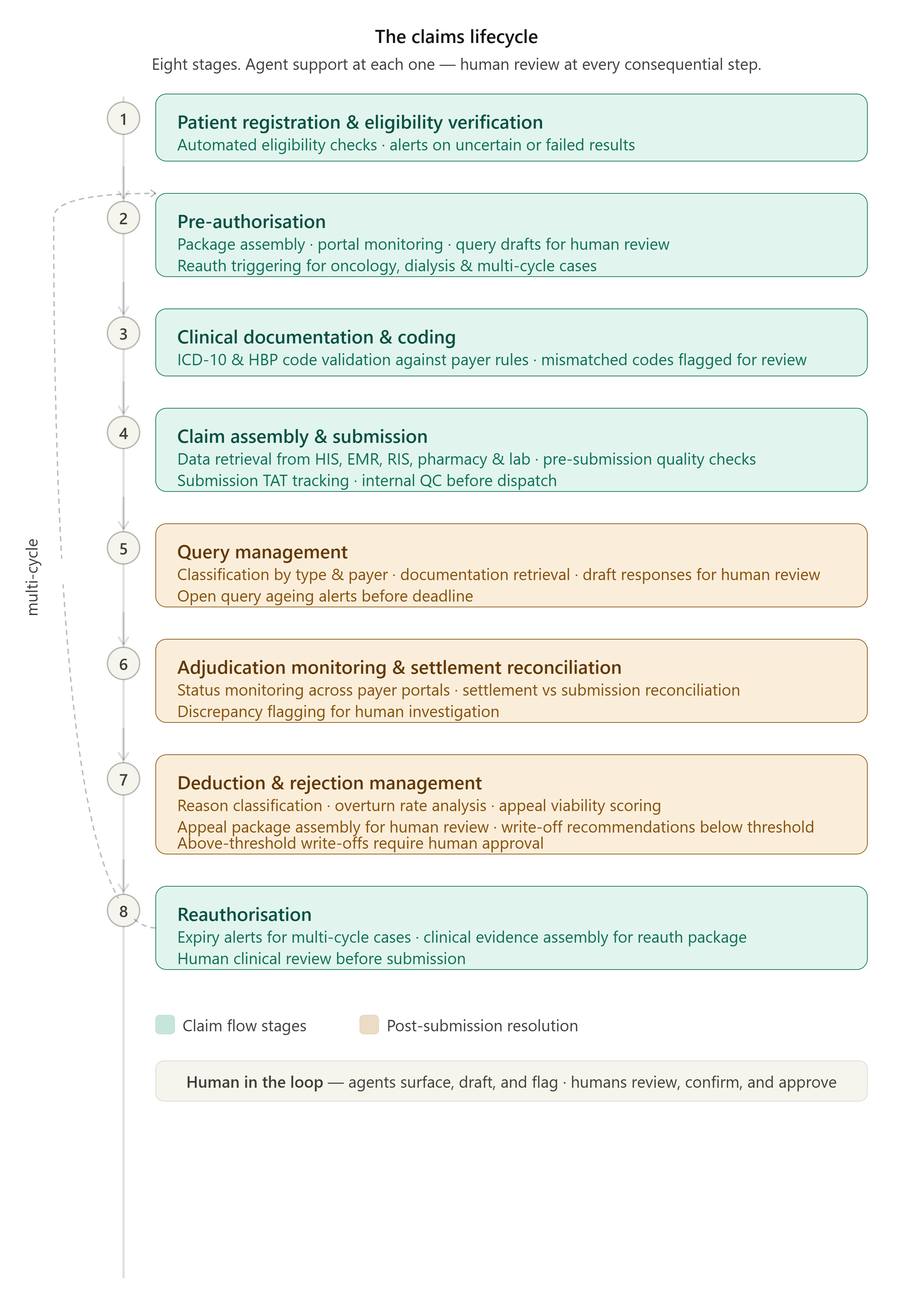
The Claims Lifecycle: eight stages, bottlenecks at each one
Every stage from patient registration through settlement carries a distinct failure mode. HealthFoundry agents support your team at each stage, reducing manual data assembly and surfacing exceptions for human review.
Payer Rule Intelligence
Payer guidelines change.
Agents that stay current.
For government scheme payers and large insurers, package and guideline changes are frequent, and non-absorption is directly penalised through deductions. HealthFoundry's Payer Rule Agent continuously monitors payer agreements for changes to package definitions, documentation requirements, and coding guidelines.
When a change is detected, the agent parses it, identifies the operational delta, and surfaces a structured update for the claims team to review. Unambiguous, low-impact updates can be applied to agent configuration after human confirmation. Ambiguous changes, where the interpretation is unclear, are presented with both interpretations and their expected financial impact, for the claims manager to confirm.
Keeping up with payer guidelines is a continuous operational responsibility, one that demands ongoing attention.
Charge Capture & Package Profitability
Not every package generates a margin.
Most hospitals don't know which ones don't.
The gap between what a procedure costs to deliver and what the payer reimburses is often invisible until it accumulates into a structural profitability problem. Our agent makes that gap visible and actionable.
Actual billing analysis
Agent reads actual billing data across procedures, service lines, and payer categories building a granular picture of what was charged for each episode of care and how it was reimbursed.
Compare with reimbursable amount
Actual cost to deliver is compared against the reimbursable package rate for each payer. Packages where the delta is consistently negative delivered at a structural loss are identified and ranked by financial impact.
Review the package master
The agent maps loss generating packages against the package master reviewing the included components, consumable assumptions, and procedure bundling to identify where the cost-reimbursement gap originates.
Package optimisation recommendations
Agent surfaces structured recommendations adjustments to package composition, consumable substitutions, or bundling changes that can improve profitability for specific packages without compromising care quality. Finance and clinical leadership review before any changes are made to the package master.
Agents
Two agents covering the revenue cycle
Every agent in the platform is semi-autonomous, it reads, analyses, surfaces, and recommends. Your team retains decision authority at every consequential step.
Works across claims management and package profitability, reviewing claims against payer rules before submission, identifying patterns in deductions and rejections, and analysing actual billing data against reimbursable amounts to surface packages that are structurally unprofitable.
- Pre-submission coding validation (ICD-10, CPT, scheme package codes)
- Denial prediction and appeal viability scoring
- Query response drafting for human review
- Actual billing vs. reimbursable amount analysis
- Package master review and profitability gap identification
- Package optimisation recommendations for human approval
Continuously monitors package-level profitability across service lines and payer categories. Reads actual billing data, compares it to reimbursable package rates, and identifies packages where the cost-to-deliver consistently exceeds reimbursement. Recommends package master changes for clinical and finance review.
- Package-level margin analysis by payer and service line
- Structural loss identification ranked by financial impact
- Package master component and bundling review
- Profitability optimisation recommendations
- Runtime package selection support to maximise margin per episode
What to Expect
Indicative outcomes across claims,
package profitability, and payer intelligence
Indicative ranges based on the Design phase. Actual improvement is anchored in your Audit baseline.
Workflow Variance Reality
No two payer relationships work the same way.
A government scheme oncology claim has fundamentally different documentation requirements, authorisation logic, and portal workflows than a commercial insurer elective surgery claim. Our methodology maps each significant payer type and claim category as a distinct workflow variant, each with its own logic and requirements.
Automation targeted at the wrong variant produces the wrong result. Our Outcomes Driven Optimization Blueprint for claims starts with your specific payer mix, procedure mix, and current KPI baseline before we configure a single agent.
| Dimension | Government / Scheme PayerOncology — Multi-cycle Treatment | Commercial InsurerElective Surgery — Single Episode |
|---|---|---|
| Authorisation requirement | Multi-disciplinary team certification required before approval | Standard pre-authorisation against policy schedule |
| Coding standard | Scheme-defined procedure package codes with strict bundling rules | ICD-10 / CPT codes aligned to insurer policy terms |
| Submission channel | Government payer portal with scheme-specific data format | Insurer portal, intermediary gateway, or EDI |
| Episode structure | Multi-cycle with reauthorisation required at each cycle | Single episode, single claim |
| Documentation checklist | Scheme-mandated documentation set, strictly enforced | Insurer-specific checklist, variable by policy |
Two claims. Same hospital. Completely different workflows.