

VitalRails
Governance, Risk & Control Continuous monitoring, not periodic audits
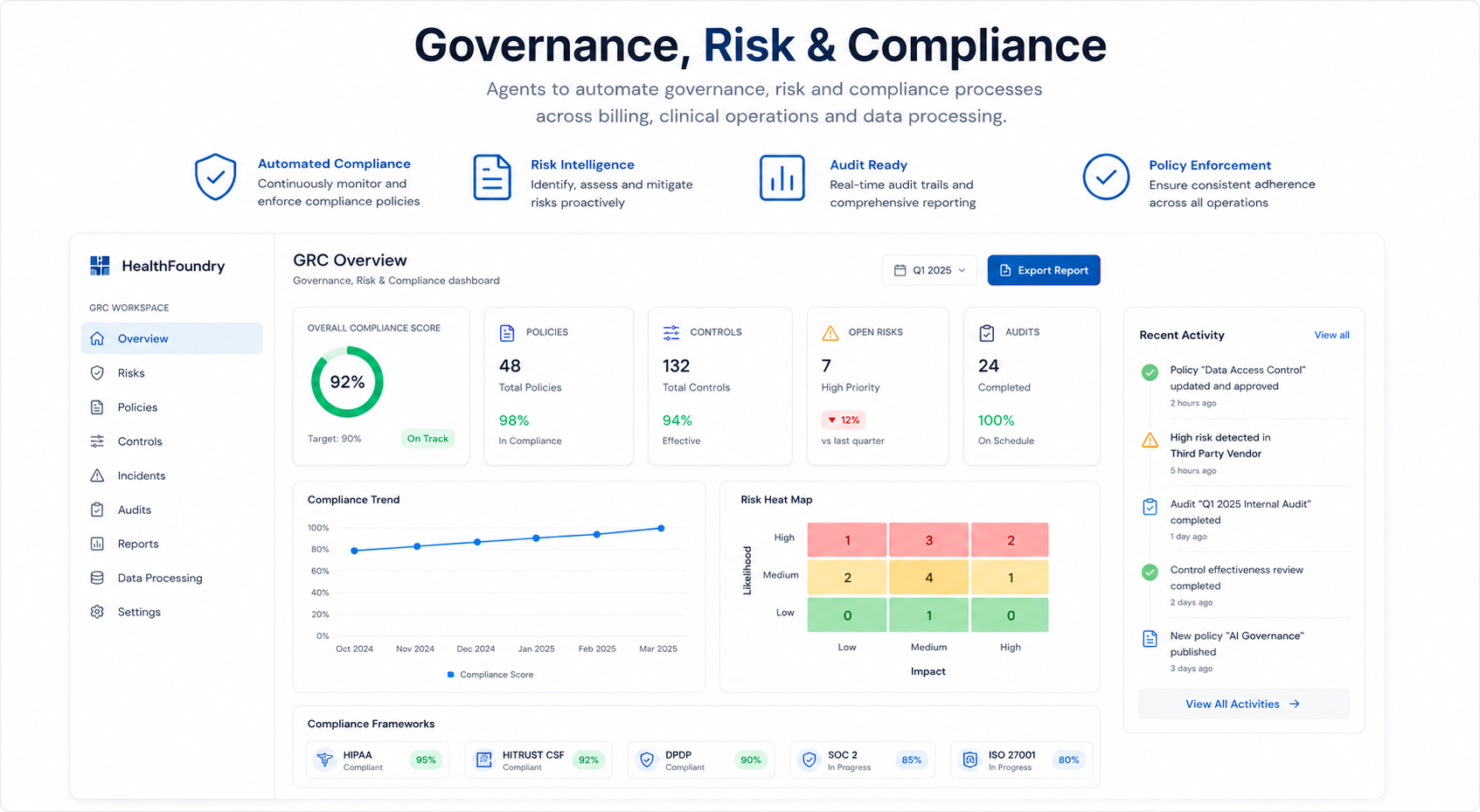
Compliance in healthcare demands continuous attention. Billing errors, invoice mismatches, clinical quality gaps, and data regulatory deviations accumulate continuously and are typically discovered after the damage is done. HealthFoundry's GRC agents monitor your operations in real time, surfacing risks for human review before they become findings.
What We Address
Five domains of continuous GRC monitoring
Our engagement begins with a structured audit of your current GRC posture before we configure a single agent. The five domains below cover all areas of operational compliance risk in healthcare.
Billing Rules Monitoring
Continuous monitoring of billing activity against payer rules, and package definitions. Human-reviewed alerts for anomalies that may indicate documentation gaps, upcoding risk, or guideline non-compliance.
Clinical Quality
Monitoring of clinical quality relative to regulatory KPIs. Flags for trending medical and nursing quality measures for correction.
Audit Trail Management
Automated maintenance of structured audit trails for clinical, billing, and operational actions. Audit ready reporting generated on demand not compiled when an inspection is announced.
Data Privacy Regulations Adherence
Monitoring for adherence to applicable data privacy regulatory frameworks like DPDP. Alert generation when patterns deviate from policy. Structured escalation to the appropriate human authority for review and action.
Risk Scoring
Continuous risk scoring across operational domains identifying which cases, departments, or billing patterns carry the highest compliance risk so human reviewers can prioritise their action effectively.
The Key Difference
Compliance risk accumulates daily.
Agents that monitor daily.
Traditional compliance depends on periodic audits which means risks accumulate for weeks or months before anyone sees them. By the time an audit surfaces a problem, the financial and regulatory damage is already done. HealthFoundry's GRC agent monitors continuously, surfacing risk flags to your compliance team before they become audit findings.
Audit finds problems from last 3 months
Damage already done
Audit finds problems from last 3 months
Damage already done
Real-time risk flags surfaced for human review
Issues caught before they become findings
Agents
One agent. Continuous coverage.
The GRC Compliance Agent is semi-autonomous, it monitors, flags, and prepares. Your compliance team reviews flagged cases and approves all remediation actions.
Monitors policy adherence, flags risk, generates audit preparation reports, and supports CAPA (Corrective and Preventive Action) documentation. Operates continuously. Human compliance team reviews flagged cases and approves remediation actions.
Continuous monitoring
- Billing activity and payer rules
- Clinical documentation completeness at billing
- Regulatory framework adherence across departments
- Risk scoring by case, department, and billing pattern
Flagging and escalation
- Anomaly alerts for risk and guideline deviations
- Structured escalation to designated compliance authority
- Prioritised action queue based on risk score
- Deviation pattern identification for upstream process changes
Audit readiness
- Automated structured audit trail maintenance
- On-demand audit ready reporting
- CAPA documentation support for human review
- Historical deviation pattern analysis for root cause review
What to Expect
Indicative outcomes from the GRC agent
Ranges are indicative. Actual outcomes are defined during the Audit phase based on your current baseline.